Friday, 15 February 2013

The terraformer’s tag

We are changing the Earth. Billions of humans are working hard to survive, to have a good life or to get a better life. So it should come with little surprise that these activities modify how our planet looks like. Pristine regions are getting rare and damaged local or regional ecosystems multiply.

Mediterranean scrub
from: http://www.arkive.org/eco-regions/
mediterranean-basin/image-H151
Looking with a trained eye on the lovely Mediterranean landscapes and seas we discover the shaping influence of some thousand years of human work. You find Roman mines and agricultural terraces high up desert hills.  The region holds many species and has a rich nature.

Most Mediterranean forests disappeared centuries ago.  The bottom of the Mediterranean Sea is is covered with litter so that you can trawl for trash and getting paid for it (*). Freshwater is limited in the Mediterranean region, average rain fall likely to diminish further because of anthropogenic climatic change, but likelihood of flash flows will increase. Often, when travelling, we mainly appreciate the sun, Mediterranean culture and food, and we like the blue waters of the sea ignoring the sewage pipes running far out into the sea discharging often poorly treated urban waters (**).  For other regions of the globe similar considerations can be made. We life on a nice, fairly habitable planet that took billions of years to form and to evolve.

Since some decades researchers started to notice that our activity impacts on planetary ecosystems and global geochemical cycles. We are an intrinsic part of this planet, actively shaping it. Those who have doubts, may consider that each year mankind moves more material as natural erosion and rivers. Our activities have increased global erosion rates by more than tenfold. That size of global anthropogenic impact is a new and global phenomenon. Front-runners started calling to name that phenomenon "Anthropocene" [1]. These front-runners consider that a new geological epoch of planet Earth  has started, the Anthropocene, because of the impact of mankind's economic activities. But when did it start - with inset of nuclear technology, with start of industrial age, or with onset of agriculture?


What's on the terraformer's mind?


Humans are many, but only quite recently. Our numbers have triplicated within some decades of the last century and hopefully will stabilize at nine billion around 2050.

Currently seven billions people are “terraforming” planet Earth. They do that simply by means of their accumulated economic incidences, which however is causing a new “planetary phenomenon” that merits to get named. Why? It's a mind thing! A name is needed to consciously gain ownership, to acknowledge that something  is happening, to reflect about its causes and implications, and to make it part of a public debate  - thus, simply for thinking "what we should do about it".

The human mind captures a “phenomenon” by giving it a name, developing a notion. Some would say it needs a  “meme” [2] to integrate a “phenomenon” into our thinking and our culture. “Anthropocene” is the notion currently emerging in science and public debate for capturing the impact of human activity on planet Earth. The notion “Anthropocene” is coined to name the geological period in which accumulated human economic activity is getting at pair with natural planetary geological or biological processes; leaving the notion "Holocene" [3] for naming the recent geological period when first signs of human impact can be identified with onset of agriculture in the neolithic revolution

Human population 1950, 2002 and 2020 (forecast)
from: http://www.eoearth.org/article/Population#gen0

 It is a very bold claim, "getting at pair”; in particular for the general public and politicians. Only recently public accepted that human activity is putting so much carbon-dioxide into the global atmosphere that its concentrations rises. Many, who share that knowledge share too the insight that air-temperatures therefore rise on a global scale and that consequently the global hydrological cycle gets modified. Likewise the same people often share the view that current ecosystem patters are under threats, as well from anthropogenic climate change as from human consumption of natural resources.  But furthering that insight to the point that our human activities force an even deeper change of the planet, a change that set a new stage of the planet needing its proper name, that is a much bolder claim. We are acknowledging and accepting that claim by naming the current change of  planet Earth “Anthropocene”, and that is a value statement. As such it reflects our ethics.
.
Carajás Mine, Brazil/NASA Earth Observatory

Gaining the insight that we are entering into the “Anthropocene” is going beyond considering  planet Earth as a planet currently under pressure but being in far more critical stage [5].

The insight that we start the Anthropocene convenes also the message that the underpinning phenomenon - “terraforming by accumulated economic incidence of several billion people” – will be a lasting process. Several billion people will not go simply away. And therefore the terraforming will go on leading into the unknown.

The insight  that we start the Anthropocene also convenes the message that conservation of current state of our planet is very unlikely to happen, because our human pressure on the planet will not decrease, at least not within several decades. Billions of humans are working hard to survive, to live good or to live better, and that will remain. There is no means to stop them striving for a better life. Life of too many people simply is too poor. 


 When did we tag? 


We seem to be many humans, but in terms of biomass our species is only a very tiny fraction of total biomass on Earth, less than 1%. Nevertheless the share of primary production we consume, in addition to fossil resources, seems to be at least close to 25%; and that more than one to twenty-five rate scales our impact (***). Following the line of thought that we, humans are the main consumer of Earth's resources, the insight that we start the Anthropocene finally convenes the message that we humans collectively are the responsible actor on whom should be called upon. Acting in a responsible manner calls on our ethics regarding how do we position us in within the planetary environment “Earth”, as individual and as species?

We could tackle that question on philosophical grounds, as humans did this since aeons.  Our myths, religions, books and minds are full of related thoughts and opinions.  To enrich these, we should ask "since when do we set our tags boldly on planet Earth?"

Human tag
from: http://moblog.net/media/e/a/r/earthlad/
tagging-riverside-update.jpg
Thus we should ask, how do we identify in a sound scientific and ethically  meaningful manner the moment in time, in history, when the impact of our economic activities on global geochemical cycles and global ecosystems was not any longer small or negligible, but reached a noticeable strength.

Did we set "the Anthropocene tag" as early as the neolithic revolution when humans were inventing agriculture and clearing out forest? Then we do rename the Holocene.  Did we set "the  Anthropocene tag" at the onset of the industrial revolution at 1850-ties when we started to  rise levels of carbon dioxide in the atmosphere? What was the change of geochemical cycles nearly two centuries ago?  Do we set "the Anthropocene tag" with the first test of nuclear explosions in 1940-ties because that technology gave us the power to start the nuclear winter mimicking the effect of an asteroid impacting Earth?


Catch the tag !


Some months ago scientists, mainly earth scientists but also academics of other disciplines, discussed in public – one conference more (#)-  that planet Earth is entering into the Anthropocene. One of main subject of their debate: “ what is an appropriate marker?” It is expected that within some years a scientific consensus will have been found. To my view, this marker should tag the geological record in a non-equivocal manner. It should be, taking a fantasy vision, be found in 100 years, 100.000 years or in 100 million years in the geological record of planet Earth.

 Keele River, McKenzie Mountains, Canada
from: http://myweb.facstaff.wwu.edu/talbot/cdgeol/
Localities/Canada.html
That "fantasy vision" is less academic as it may look like on first sight. It sharpens the focus for the kind of event the Anthropocene may be. The mayor events that did hit Earth are well recorded in the geological record. For example, the rise of free oxygen in the atmosphere and the ocean is recorded in mighty deposits of iron-ore. The great unconformities [4] mark cycles of  continent formation, and the Cambrian surge of marine live is preserved in many fossils.  We know also about the impact of a meteor, leaving a spike of Iridium, and the basalt flows of Deccan Traps hat marked jointly the fate of the dinosaurs and may other species. We know about the drying out of the Mediterranean Sea, the Messinian salinity crisis when the Straits of Gibraltar were closed.  We know about the years without summer after mayor volcano explosions recently such as the Tambora (1815) or a bit earlier the Toba 74.000 years ago that possibly nearly wiped out humans. As well we know of the mighty tsunami that hit the North Sea after the Storegga land slide at Norwegian continental margin. All these events leave markers in the regional and global geological record. So what if human economic activity currently leaves such a marker at global scale? Are we caught in the act to tag the globe?

It is straight geological practice to determine periods of the development of our planet by referring to the stratigraphic record as it is held, for example, in rock, ice, sediment, peat or soil. Considering that practice a way to assess whether we are entering into the Anthropocene is to seek how our human activity currently gets registered in the these records.


My favourite tag !


My favourite candidate for such a record are the sediments that currently form in the seas, be it in coastal zones for local record, in self-seas for regional records and in the deep see for a global record. Lake sediments possibly could be added as reference site for recording change, particular in deep lakes that were carved out in the last ice ages, such as Lake Geneva and other lakes at the foots of alpine mountain ranges. One should not forget neither records taken in peat, ice or soils.

What do the marine sediments gather?
  • Water molecules are reacting in a slightly different manner in the hydrological cycle depending on the oxygen isotope bound in it and get so fractionated. An increased global temperature influences these processes. The different isotope ratio as well as the related temperatures are recorded in the manner how oxygen isotopes are incorporated in shells of plankton that sink to the bottom of seas and lakes. [6]
  • The burning of coal and oil influences the ratio of the various carbon isotopes in the global atmosphere. These isotopes are reacting in a slightly different manner in biological processes and so get fractionated.  Measurements 
    Marine litter
    from: http://www.globalgarbage.org/blog/
       show for the last decades a change of carbon isotope ratio in the atmosphere. Thus carbon isotope composition of biomass shifts too. Peat, soil and many sediments will preserve biomass be it as fossils or as biological tracers. [6]
  • The pollution of the global environment by well identified substances can be measured on global scale. Many of these substance may not preserve for long time but some will do, such as lead from fuel-additives or radionuclides  from nuclear tests, from nuclear accidents or from processing of nuclear waste. These elements are characteristic and the decay products of radionuclides provide too for a clock to date the layer. [7]
  • Litter is present in all oceans and sea. It is a global problem, observed in the water column as  well at the sea bottom. The concentration of litter, such as plastic and glass, is particular high in shelf-sea regions and in coastal zones and the litter is incorporated in the marine sediments. In the same moment the hydraulic regime of many rivers is modified by human activity and their sediment load is modified too. Thus sedimentation rates in coastal plains shift. [8]
  • Bottom trawling in shelf-seas is reworking the bottom to a depth of several centimetres and large areas in may shelf-seas are touched. Massive bottom trawling, also in deeper shelf waters, happens since some decades up to the point that roughness of the sea bottom gets smoothed. Bottom trawling destroys the habitual benthic communities and the reworking of the sediments. Worms and their burrows are gone. [9]

Trace of bottom trawling [9]
Thus with a little bit of imagination, sediment layers that are formed currently around the globe have different chemical, physical and biological characteristics as in the past.  They are tagged with radionuclides and litter-fossils. The bottom trawling is a powerful process to mix the top-layer and change the benthic living there. The currently formed top sediment layer will separate sediment layers for which ratios of carbon and oxygen isotopes will be  different.

Likewise chemical and isotope markers are found in ice, peat and soil all over the globe. But sediment layers in coastal seas and shelf seas should change most prominently. There our impacts of human activity cumulate.  That is the tag of the onset of the Anthropocene!

 Ukko El'Hob


(*) http://www.ssireview.org/articles/entry/whats_next_trawling_for_trash

(**) Flying to Mallorca under right conditions (calm sea) you can see the outfall of Palma de Mallorca and the wast water plume rising to the surface.

(***) Figure difficult to obtain with some certainty but likely the ratio is bigger than 1 : 25

(#) R. Showstake, Scientists Debate Whether the Anthropocene Should Be a New Geological Epoch; Eos, Vol. 94(5), 2013

[1] Quote from Wikipedia (simplified): Stoermer originally coined and used the term Anthropocene from the early 1980s to refer to the impact and evidence for the impact of human activities on the planet earth. The word was not used in general culture until it was popularized in 2000 by Nobel Prize-winning atmospheric chemist Paul Crutzen and others who regard the influence of human behaviour on Earth's atmosphere in recent centuries as so significant as to constitute a new geological epoch.

[2] Quote from Wikkipedia (simplified): A meme is an idea, behaviour or style that spreads from person to person within a culture. A meme acts as a unit for carrying cultural ideas, symbols or practices, which can be transmitted from one mind to another through writing, speech, gestures, rituals or other imitable phenomena. Supporters of the concept regard memes as cultural analogues to genes in that they self-replicate, mutate and respond to selective pressures. The word meme is coined by the British evolutionary biologist Richard Dawkins as a concept for discussion of evolutionary principles in explaining the spread of ideas and cultural phenomena.  Proponents theorize that memes may evolve by natural selection in a manner analogous to that of biological evolution. Memes do this through the processes of variation, mutation, competition and inheritance, each of which influence a meme's reproductive success. Memes spread through the behaviours that they generate in their hosts. Memes that propagate less prolifically may become extinct, while others may survive, spread and (for better or for worse) mutate. Memes that replicate most effectively enjoy more success, and some may replicate effectively even when they prove to be detrimental to the welfare of their hosts.

[3]  Quote from Wikkipedia (simplified): The Holocene is a geological epoch which began at the end of the Pleistocene (around 12,000 to 11,500 years ago) and continues to the present. The Holocene also encompasses within it the growth and impacts of the human species world-wide. Human impacts of the modern era on the Earth and its ecosystems may be considered of global significance for future evolution of living species, including approximately synchronous lithospheric evidence, or more recently atmospheric evidence of human impacts. Given these, a new term Anthropocene, is specifically proposed and used informally only for the very latest part of modern history and of significant human impact.

[4]  Quote from Wikkipedia (simplified): The "great" unconformities of regional or continental scale (in both geography and chronology) are associated with the super-continent cycle, the periodic merger of all the continents into one approximately every 500 million years.  

[5] Quote from "State of the Planet Declaration" (simplified, adopted in 2012 at conference "Planet under pressure"): Research now demonstrates that the continued functioning of the Earth system as it has supported the well-being of human civilization in recent centuries is at risk. In one lifetime our increasingly interconnected and interdependent economic, social, cultural and political systems have come to place pressures on the environment that may cause fundamental changes in the Earth system and move us beyond safe natural boundaries. The defining challenge of our age is to safeguard Earth’s natural processes to ensure the well-being of civilization while eradicating poverty, reducing conflict over resources, and supporting human and ecosystem health. As consumption accelerates everywhere and world population rises, it is no longer sufficient to work towards a distant ideal of sustainable development. Global sustainability must become a foundation of society. It can and must be part of the bedrock of nation states and the fabric of societies. 

 [6] An easy to read and comprehsiv description of process and phenomenons related to fate of oxygen or carbon isotopes in geochemical cycles is found in "How to build a habitable Planet" by Ch. H: Langmuir and W. Broecker, Princton University Press 2012, pp. 718.

[7] Example of two publications about anthropogenic radionuclides in the North Sea; (1990) http://www.sciencedirect.com/science/article/pii/092479639500026L or (2011)  http://www.ams.ethz.ch/publications/annual_reports/2011/081

[8] Quote from abstract (simplified) "Litter on the Sea Floor Along European Coasts" (F: Galgani, Marine Pollution Bulletin, 40(6), 2000: The distribution of large marine debris were investigated on continental shelves of European Seas on the basis of 27 oceanographic cruises; different types of debris were enumerated, particularly pieces of plastic, plastic and glass bottles, metallic objects, glass, and diverse materials including fishing gear. The results showed considerable geographical variation in concentrations, which ranged from 0 to 101 000 pieces of debris per km x km; plastic (mainly bags and bottles) accounted for a very high percentage (more than 70%) of total number of debris; mostly in canyons descending from the continental slope and in the bathyal plain where high amounts were found down to more than 500 m.

[9] http://www.scientificamerican.com/article.cfm?id=bottom-trawling-fishing-levels-ocean-bottom

Monday, 4 February 2013

Now the Anthropocene, or what?

Why should I care?
Why to care whether the current geological times should be called “Anthropocene”?

Why do researchers undertake the endeavour, whether to call the current times "Anthropocene"; an undertaking that some label “insanely complicated” so Jan Zalasiewicz [#], but for whom it “is a great way of increasing understanding of the world we live in and what we are doing to it in this particular instance”. [*]

Earth at night
from: http://en.wikipedia.org/wiki/File:Earthlights_dmsp.jpg
What kind of "geo-marker" would be the most suitable label of the onset of the "Anthopocene", that debate could be put aside when recognizing what political impact this debate could have.

Recognizing that the combined efforts of humans work and living changes the development path of the globe implies to take a different ethical position towards the globe as many take today. Recognizing our times as "Anthropocene" means recognizing simply that we are de-facto geo-engineering the Earth, whether we like it or not. And any engineer has to assume responsibility for its design.  That is the political message behind adopting the name "Anthropocene" for our times. 

Currently “Scientists... acknowledged widespread anthropogenic changes to the Earth's surface, subsurface, atmosphere and waters from mining, development, agriculture, the impacts of climate change, air and water pollution, trawling and dredging, and many other activities.” [*] However taking that widespread understanding forward, namely to enshrine in the common, official scientific understanding that we, humans, made entering Earth in the new geological epoch, the “Anthropocene”, that is a very big step.  

from: http://library.hrmtc.com/2011/05/31
/anthropocene/
Taking this step would be even bigger for the public at large and governments. Just consider that currently public awareness for climate change is solid, including noticeable opposition towards recognizing anthropogenic climate change. That kind opposition would be small compared to what to expect when broadening the insight of an "anthropogenic climate change", namely to understand our (geological) times as “Anthropocene” because of man-made "anthropogenic global change". But just that broadening of insight is getting on the agenda now: "The 'Anthropocene' has emerged as a popular scientific term used by scientists, the scientifically engaged public and the media to designate the period of Earth's history during which humans have a decisive influence on the state, dynamics and future of the Earth system. It is widely agreed that the Earth is currently in this state." [##]

When public at large and governments would considering "living in the Anthropocene" then it would imply too the insight to undertake global stewardship. And stewardship, as a manner of responsible living and acting, is something to what most laymen would underwrite, simply because it reflects their habitual ethics. Evidently there would be much debate about what that stewardship would mean to do, but the basic insight of care-taking and stewardship will be very popular. Thus once public is getting convinced, one may expect that the notions of Anthropocene and stewardship would get deeply routed. However, that level of public insight is far away, and much of the challenges that could be enshrined in this insight will depend how, in contemporary or historical context, the boundary between Holocene [1] and Anthropocene [2] is set - or whether both are about synchronous for historical times, and thus the Anthropocene is our business as usual.

Currently the Anthropocene has got no precise start date, but settling that is just the purpose of the ongoing scientific debate,which may come to its end in some years.. Based on evidence from atmospheric sciences the Anthropocene may be considered to start with the Industrial Revolution in the late eighteenth century. Other earlier events, such as the rise of agriculture ten-thousand years ago, has been advocated too. Evidence of global human impact on ecosystem-use, biodiversity, and species extinction still is somewhat controversial as well has man-kinds impact on the global hydrological cycles, up to shifting salinity of the global ocean [***]. But that evidence is rapidly accumulating.

from: http://www.atmos.washington.edu/
~robwood/Geoengineering/
Currently we witness first steps that the notion “Anthopocence” is going public; e.g. it is part of the sphere of matters described in Wikipedia. Therefore it may sound typical scientific insider-talk, saying that the formalization of a new epoch requires that it meet strict protocols, including whether the onset of the Anthropocene can be clearly distinguished at the same time in different locations around the world”. But setting a global "geo-marker" that can be observed around the globe is a most important foundation to start a convincing debate about us making and living in the Anthropocene. Therefore setting that  "geo-marker" should be done with care. However the related ethical debate, geoethics, about our responsible stewardship of the Earth as integral part of its functioning can be part of the Commons and laymen's thinking already now.

Ukko El'Hob

[1] from Wikipedia: “The Holocene is a geological epoch which began at the end of the Pleistocene (around 12,000 to 11,500 14C years ago[***]) and continues to the present. The Holocene is part of the Quaternary period. Its name comes from the Greek words ὅλος (holos, whole or entire) and καινός (kainos, new), meaning "entirely recent". It has been identified with the current warm period,... and based on that past evidence, can be considered an interglacial in the current ice age. The Holocene also encompasses within it the growth and impacts of the human species world-wide, including all its written history and overall significant transition toward urban living in the present. Given these, a new term Anthropocene, is specifically proposed and used informally for the latest part of this epoch since approximately synchronous lithospheric evidence, or more recently atmospheric evidence, of human impacts have been found on the Earth and its ecosystems; these impacts may be considered of global significance for future evolution of living species.”

[2] from Wikipedia: “The Anthropocene is an informal geologic chronological term that serves to mark the evidence and extent of human activities that have had a significant global impact on the Earth's ecosystems. The term was coined recently by ecologist Eugene F. Stoermer, but has been widely popularized by the Nobel Prize-winning atmospheric chemist, Paul Crutzen, who regards the influence of human behaviour on the Earth's atmosphere in recent centuries as so significant as to constitute a new geological epoch for its lithosphere.” .

 [#] convener of the Working Group on the Anthropocene, senior lecturer in palaeobiology, University of Leicester, UK; see: http://www.quaternary.stratigraphy.org.uk/workinggroups/anthropocene/
[##] http://www.quaternary.stratigraphy.org.uk/workinggroups/anthropocene/
[*] EOS, Transactions American Geophysical Union, 94(4) p. 41-42, 2013;
[**] Pierce et al., "The fingerprint of human-induced changes in the ocean's salinity and temperature fields",  Geophysical Research Letters 39(21), 2012;
[***] "14C years" years measured by the decay of a radioactive carbon isotope, about equal to calendar years;

Tuesday, 13 November 2012

Timeline to the Noosphere


First the Geosphere, then the Biosphere, now the Noosphere - this is the time-line of evolution. Initially was the emergence of the geosphere. It followed the biological evolution, which was leading to the consecutive development of cell-body-systems and body-mind-systems. Offspring of the latter were mind-culture-systems, societies. All these systems rely on processes to process information and to handle communication. So far the conceptual, generalizing layout, but how goes the storyline


To start off simple...

Initially, 10 billion years ago, stars formed of hydrogen only. Hydrogen is the most simple chemical element combining a single proton and a single electron. The initial stars fused in their cores hydrogen, the most simple chemical element, to more complex chemical elements such as carbon or iron. Now minerals could develop combining different chemical elements.

When these minerals aggregated to planets, like Earth several billion years ago, they evolve in a new fashion. Chemical process transform the minerals and eventually geochemistry of planets as well as geology of planets developed. Different chemical processes combine into process loops, and the Geosphere is forming. Different reservoirs of the Geosphere exchange matter and the matter flows in closed pathways repetitively through geochemical cycles.

Eventually, increasingly complex repetitive chemical processes developed. These processes get more complex than simple transformation of minerals in geochemical cycles. Special processes happen preferably at mineral surfaces. These surfaces provide geometrical shapes that ease the development of complex chemical structures including their replication. Eventually, replication of complex chemical structures was getting an abundant process on Earth some billion years ago. At that moment, Earth’s chemical processes had evolved to a stage "living beings" could emerge. Replication of structures is an essential, primary key feature of life. Eventually, the replication process led to reproduction. This happens once the replication process changed, and the replication process produced "more of about the same"


To get a bit evolved...

Initially the most simple "living beings" consist in closed boundary layers, which are segregating a bit of matter. The boundary layer encloses the replication process. The boundary layers segregate the "living beings" from each other and other matter. Boundary layers are further fundamental key-feature of "living beings" because they are interfaces that control interaction; interaction between different "living beings" and between them and their environment. These interactions include selected fluxes of matter and information across the boundary layer. This is the onset of biological evolution. Once the biological evolution covers the globe and feeds back into the chemical-geological evolution of the Earth, then the Biosphere is forming.

Controlled interaction of "living beings" ends when they die. Then the protecting boundary layer are breaking up. Therefore for a lasting, perennial existence of life "living beings" have to replicate before they die. Thus, survival of a species requires to self-replicate sufficiently often before breaking up. A "living being" may survive if the self-replication or reproduction process produces copies of it in sufficient quantity and quality.

These copies do not have to be perfect; just "a-bit-more-of-about-the-same" will do the job. The copies have to match to the environment. Reproduction is a "copy-and-paste-me-into-the-environment-process" that produces a "bit more of about the same". The slight variation of the replicated "living being", when compared to its ancestor, is essential for survival. It is a means to cope with environmental change.

Variation is intrinsic to any faulty replication process of a kind that produces “just about the same”. Accurate, faithful replication will hinder survival because of misfitting to an environment that has changed. On the other side, severe faulty replication would hinder survival because of loosing functionality of the “living being”. The trick for survival is to replicate in high quantity and each replication being a slight variation. Biological evolution has to followed that approach. Evolution traced a path muddling through a wide range of possible changes.

Knowing about the environment is the key-strategy to find this path; a very successful strategy indeed, as evolution showed. It has lead to the development of receptors, sensors, signalling systems, nervous systems, and eventually brains, minds and culture. All these different features of living  beings have in common that they are means to capture and process information about the environment with the purpose to better manage the exchange processes with the environment. In the end, it leads to getting a better control of the various exchanges processes in support of survival through reproduction.


To add a bit of complexity...

Evolved brains, thus very complex nervous systems are carriers of minds, or intelligence - initially very simple with limited skills. Minds have emerged as a new feature in course of the evolution of "living beings" once the complexity of their nervous systems had increased sufficiently. Minds are internal, virtual representations of the outer world, the environment around the "living beings". The brain holds these representations; thus it is the carrier of the mind.

The information about the external environment, which is hold in the mind, results from inputs captured by the receptors and interpreted by sensors. These inputs trigger signals. The nervous system transmits these signals. The brain processes theses signals. A mental object forms. Eventually a previous representation of the outer world in the mind, or mental object, modifies, and the mind perceives the external environment differently. These perceptions are internal to the “living being”, are virtual, and are mental objects. They are formed from heavily processed signals. This internal, virtual mental objects may be a distorted image of the external world. The mental object may evolve due to intrinsic processes of the brain, getting disparate from a faithful representation of the external environment. Nevertheless these virtual mental objects are significant drivers for the “living being”. Some hundred million years ago these drivers were a new feature produced by the evolution. Mind-setting was the new game to play for survival and reproduction. Even further evolved minds include also an internal, virtual representation of its carrier, the "living being". This particular mental object has the purpose to steer, manipulate, plan etc. actions of the carrier in the external environment.

Nervous system including the brain and the mind find their analogy in the computer hardware and the computer software. The hardware is the carrier to run the software. Hardware and software have to match for essential features otherwise the software does not function. The brain, the nervous system, and the body are the hardware on which the software, the mind, runs. The essential characteristics of the brain determine the manner how the mind functions. However, beyond the matching of essential features, a variety of minds can be carried by the same brain or nervous system. The essential function of the system "body-mind" is the same as in earlier stages of the evolution. Namely, to replicate the “living being”, and that in a quality and quantity which is at least “a bit more of about the same”. Thus, to survive as a species the body and the mind have to evolve jointly.

Evolution of minds opens options for cooperation and bonding between individuals. Individuals are similar but not identical body-mind-systems. The evolution of the bonded individuals or groups leads to sharing of know-how and ultimately to the emergence of craftsmanship, arts, culture and technology as new features of the external environment. The individuals act coordinated as groups, networks or societies shaping the environment in which, in order to survive, they have to reproduce in a quality and quantity that is at least “a bit more of about the same”; the Noosphere is getting established.


On the way out...

Much has happened since stars lighted up. Today, the number of human beings and their manner of reproduction are such that we squeeze the biosphere of planet Earth. The combined strength of humans is such that we shape the Geosphere of planet Earth starting the Anthropocene. Where do we go from here? Evolution will continue on its path building complex systems using simple building blocks. We will evolve beyond us. Increasingly complex technologies will open development paths to new self-replicating systems that differ from the the body-mind-systems as we know them today. These systems will reproduce themselves “about the same”, will carry internal representations of their own structures and their environment, and these beings will belong with us, as part of us to the Noosphere..

P.s......if we do not crash this planet

update 27th October 2013

Ukko El'Hob

Sunday, 30 September 2012

Reaching the Anthropocene !

Humanity today is like a dreamer, caught between the fantasies of sleep and the chaos of the real world. We created a Star Wars civilization, with Stone Age emotions, Medieval Institutions, God-like technology. [1]


Evolution for ever…

We are the Anthopocene
(from: http://www.nytimes.com/)
Evolution of Earth is billion-years-story-line about how to increase diversity, enlarge options and finally reaching the Anthropocene.

Chemical, geological, and biological evolution of our plant shaped its fate and drove it through tremendous changes, such as setting up an atmosphere containing free oxygen. But recently evolution has set free the most vigorous driver of its evolution, humans. Within a tiny elapse of time this mind-powered, bonding-driven and tribe-centred cooperators conquered Earth. Humans are now challenging the state of the planet.

Human social systems and their economies now have the power to shape our planet, for the better or for the worse [a]. How did we arrive there? It started a little 14 Billion years ago.

Story one... 

Fusion outburst of the sun
(from: http://blondesearch.ru/)
Following the Big Bang rapidly the evolution of chemical elements started. Nuclear fusion in the first suns burns hydrogen to deuterium, to helium and helium to lithium. Matter ejected at end of  live-cycle  of these suns is gathered in new suns and there it is fused to chemical elements like carbon, nitrogen or iron. Supernovas throw these elements out into deep space, gravity aggregated them to new suns. For many hundred millions years this evolution of more and more complex chemical elements went on. Once having advanced building more and more complex elements chemistry finally could start adding other complexities to a world previously dominated by physics only.

A new kind of interaction of elements came possible that kept their nature when they met and aggregated; chemical reactions. The aggregation may break up and its initial elements can enter unaltered into new, different aggregations (molecules). Fusion merges elements into new elements. Their fission, if possible, does not produce the initial elements unaltered. Increasing number of chemical aggregates, minerals, came possible once fusion in stars had produced elements such as carbon, oxygen, aluminium, silicate or iron. New worlds came possible, such as icy comets or rocky planets

Story two... 

A step further down the time-line,  when rocky planets like Earth had formed,  their geology could evolve from chemistry. The evolution of planets could take off [2]. Enriched mineralogy of the planet  evolved and preceded biological evolution. Biological evolution was evolving out of increasingly complex chemical reactions that came possible now when building on the recycling of matter in the geological processes of  planet Earth. Intrinsic question, what path of chemical-geological evolution of  planets opens the path to biological evolution - see Mars and Venus for possible dead-ends, but wait for surprises from rocky-icy moons of Jupiter and Saturn.

Planet Earth - current configuration
(from: http://scienceblog.com/)
Biological evolution is happening first on the level of very complex molecules. Reproduction of about the same is added as new and essential main pattern of change. From now on biological evolution will be the main driver of change for billions of years. Survival, simply be lasting reproduction of about the same, is now the key notion.

Biology added new forms of beings to a world previously dominated by physics and chemistry, and geology of the planet got complexer. Biological and chemical process took many millions years to assemble first single-cell organisms having stable mechanisms to achieve reproduction. These stable carriers of "reproduction of about the same" evolved to multi-cell organisms, being even better carriers for  "reproduction of about the same". In the same time the chemical evolution of the planet continued; free oxygen in the atmosphere changed completely the face of the Earth, including its geology. In the end the oxygen-rich atmosphere opened evolutionary paths towards mobile and information-gathering beings of high energy consumption, animals. 

Live began to shape Earth, in the sea and on land, be it as plant or as animal. Reproduction is the game, survive through reproduction. Biological evolution of bodies, organs and senses got complemented by evolution of nerve systems that support complex behaviours, tuned to survival and better reproduction.  Astonishing interactions of individuals, such as insects in colonies, fish in swarms, wolfs in packs, entered into the picture. Interactions tuned to support the survival of the kin.  Complexity of nervous systems and brains increased and now evolution of minds could set in; minds with the function to support intelligent interaction of individuals for their selfish and common benefits.

Story three... 

Evolution of mind and culture began. Groups of late primates and early humans started using tools, fires and camp-sites. Furry plant gathering  knuckle-walking species evolved to hairless, sweating, game hunting species. Hounding in groups and maintaining the camp-site requires cooperation, going beyond selfishness and caring only for your kin.

San hunters - using techniques of group hounding
(from: http://cdn.wanderlust.co.uk/)
At this stage, processes had to emerge at group level that were fostering bonding within the group to ease cooperation and thus to enhanced likelihood of reproduction of the group. Evolution on group level triggers in. The evolutionary process is acting also on the level of mental processes, thus the evolution of the brain. The brain has to be the carrier of new skills, such as anticipating intentions of the other human so that the own behaviour gets adapted to it.

These new skills helped to built and share ideas, attitudes and techniques among members of a group, who bond with each other, building an even tighter knitted community – brain for culture.  Cooperation in competition, own reproduction and fitness of the kin, and reproduction and fitness of the group gets closer and closer dovetailed. History emerged, advanced cultures as complex pattern of values, ideas, behaviours, favoured skills and preferred techniques emerged too. Now these cultures are complex carriers for successful reproduction, lesser for the individual or kin but for the group. [3]

Nearly now and here...

There we are, humans today. The story-line is still a fascinating suite of bold steps; and many of their details have to be filled in. But what does it mean for us - here and now at the verge of Anthrophocene - for our societies, their infighting and their cooperation? It tells us from where our history started and what has driven us to a fair degree, and possibly will continue to drive us. 

Network - who links whom?
(from: http://itcilo.wordpress.com/)
Thus, we should acknowledge that bonding in tribes, groups and recently in social networks are part of our home. It is a part of our identity-finding that is set in mind, although not in stone [6]. Million years of evolution shaped our mind for betting our own survival on that of our group.  Successful cooperation within the group secures reproduction. Cooperation is a wired-in mind-thing, a common culture-thing. The culture maps the minds.

Over the last million of years our mind and therefore our brain had to evolve to deliver a mind having competitive edge, for the group. Mind-based cooperation has to over-balanced individual selfishness, and did so up to the point that we armed our minds and cultures with possible justification for self-sacrfiying actions for the benefit of the group. Mind and therefore brain have evolved to deliver drivers that can out-power selfishness. These divers come in different forms, such as emotions, mental maps of the other, irrationality-rationality, storytelling and myths, the latter including religion as one of the most powerful drivers. All these divers shall foster bonding and cooperation within the group helping to fight off or to compete out the other group. Up to the point - we shall survive they shall perish!

... promising abundance if...
(from: http://www.washingtonvoz.com/)
Since Palaeolithic times each of the countless thousands tribes invented its own creation myth. During this long dream-time of our ancestors, supernatural beings spoke to shamans and prophets identifying themselves to the mortals as gods; gods being shaped by the environments of those who invented them.The creation stories gave the members of the tribe an explanation for their existence. The creation myth was the essential bond that held the tribe together. No tribe could long survive without it. The creation myth is a Darwinian device; it was the principal diving force that shaped biological human nature, mind and brain. Consciousness driven by emotions, having evolved over millions of years of life-and-death struggle was designed for survival and reproduction. Pre-humans had to rely on bonding and cooperation among individuals. Bonding is based on cooperation among individuals or groups who know one another and are capable of distributing ownership and status on a personal basis. [1]


Onward...

...wise villager...
(from: http://www.kolumbus.fi/leo.mirala/)
If we are "...like a dreamer, caught between the fantasies of sleep and the chaos of the real world..." but having  "...created a Star Wars civilization with Stone Age emotions..."  using "...Medieval Institutions, God-like technology..." then we have to acknowledge that state of our mind. We have no other, no better mind. 

So, we should do what evolution taught us best, namely bonding a group by a common culture that is geared to maintain reproduction of the group. Thus we should build the global village on our planet using the best means and insights we have [4, 5] and getting as many humans involved as possible.

A village rarely is an idyllic place. However normally is sufficiently productive and peaceful to sustain reproduction of the villagers. And that's in the first place "why we are about" and "what we are", as the story-line of evolution tells. There is not more intelligence in our design. Being soon a bit more than seven billion humans on Earth we have no other choice but shaping the Anthropocene of planet Earth. So let's build that village, rapidly.

Ukko El'Hob

[1] "The social conquest of earth" by Edward O. Wilson, quoted;

[2] "The Story of Earth: The first 4.5 Billion Years, from Stardust to a Living Planet." by Robert M. Hazen;

[3] "Wired for Culture. Origins of the Human Social Mind" by Mark Pagel;

[4] "Abundance: The Future Is Better Than You Think" by Peter H. Diamandis;

[5] "Planet under Pressure"

[6] Human behaviour: A cooperative instinct, Simon Gaechter, NATURE

[a]  see: http://ukkoelhob.blogspot.de/2012/04/in-pressure-cooker-surveival-strategy.html 


Monday, 20 August 2012

The sucking sound in the ground

Groundwater hold in aquifers is a life-sustaining resource that supplies directly water to billions of people, for drinking, daily domestic use, agriculture and livestock. About 1.7 billion people live in areas where groundwater resources or groundwater-dependent ecosystems are under threat because of their over-exploitation. Thus, almost one-quarter of the world’s population lives in regions where groundwater is being used up faster than it can be replenished. Often it is a resource that was built-up under past climates as the Nubian Sand Stone aquifer under the Sahara.

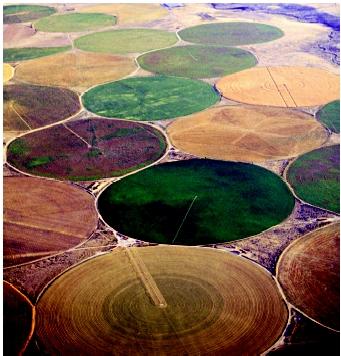
Fields irrigated with water from Ogallala aquifer
Often aquifers are over-exploited in are areas in which precipitation is scare or seasonal and  thus productive agriculture requires use of ground water, such as in the west of USA where agiculture is supported by the Ogallala aquifer. There use of ground water plays a central part in irrigated agriculture and  rising livestock that requires large amounts of water.  Likewise, presence of ground water is "just" beneficial for the health of many ecosystems, as for example it hinders intrusion of seawater into coastal plains.

Across the world, human civilisations depend largely on tapping vast reservoirs of water that have been stored for up to thousands of years in sand, clay and rock deep underground. These massive aquifers — which in some cases stretch across multiple states and country borders — provide water for drinking and crop irrigation, as well as to support ecosystems. Modern pumping technology and traditional property laws make water in these aquifers cheap and accessible to industrial agriculture. 
Water level drop up to 40 feet (deep brown)
between 1980 1nd 1995
Un-sustainable depletion of groundwater is described by a “groundwater footprint” [1]. The "groundwater footprint" is the area required to sustain groundwater use and groundwater-dependent ecosystem services. Currently humans are over-exploiting many large aquifers that are critical to agriculture, especially in Asia and North America  including many of the world’s major agricultural regions;  in the Central Valley in California, the Nile delta region of Egypt, and the Upper Ganges in India and Pakistan, demand exceeds these reservoirs' capacity for renewal.

The size of the global "groundwater footprint" is currently about 3.5 times the actual area of aquifers [1] because 20% of the world’s aquifers are being massively over-exploited. For example, the groundwater footprint for the Upper Ganges aquifer is more than 50 times the size of its aquifer.

Ukko El'Hob

Reworked from:


[1] Water balance of global aquifers revealed by groundwater footprint; Tom Gleeson, Yoshihide Wada, Marc F. P. Bierkens & Ludovicus P. H. van Beek & Groundwater use is unsustainable in many of the world's major agricultural zones. Amanda Mascarelli, NATURE,  08 August 2012

Tuesday, 7 August 2012

Folding Earth's Timeline

Evolution did a great job. Although, it took its time – 4.7 Billion years.  But how long are 4.700.000.000 years ? Any chance to feel how long is that elapse of time ?  How to fold that line of millions, billions of years so that it feels like a human timeline? 

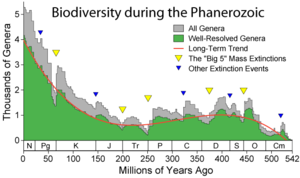
Marine Fossil Biodiversity since half a Billion years
(from Wikipedia)
What about counting years of Earth history as seconds of human life? Sixty seconds add to a minute, three-thousand six-hundred seconds add to an hour, eighty-six-thousand our-hundred add to a day, and thirty-one-million-five-hundred-thirty-six-thousand seconds add to a year (1); and so on.

A second feels like an elapse of time that we know. A year feels like an elapse of time that we know  too. A year counts for many seconds, namely thirty-one-million-five-hundred-thirty-six-thousand; what sounds “a lot”. That “thirty-one-million… number” does not feel specific, although a year feels specific and a second feels specific too.  So, feeling a second, feeling a year and feeling the difference between both elapses of time gives a quite particular spread of perception of how much that “thirty-one-million… something” is.  That spread of perception could be used to fold the timeline of Earth’s history onto a human timeline. 


A fairy tale…?

Thus, imagine to count a year as “a second of Earth's life”. Then, "a minute of Earth's life” would make most of a human life time. "An hour of Earth's life” would cover most of the period for which we, humans have some written records. "A day of Earth's life” would go back to times when our human species had evolved in Africa, just more or less ready to conquer the globe and to replace other human species. And "a year of Earth's life” would go back before modern fauna evolved, before continents had drifted to their present positions, before rapidly cooling Antarctica had become more isolated, and before the Antarctic Circumpolar Current had to start flowing. Thus within "a year of Earth's life” major biological, climatic and geological changes of the earth system occur.


Acasta gneiss, one of the oldest rocks on Earth. (2)
Counting a year as a “second of Earth's life” folds Earth’s history on timeline that can be captured by human perception. Counting 4.7 Billion years as 4,700,000,000 “earth-seconds” make hundred-forty-nine “earth years”. A human life would last 60 to 90 “earth-seconds”. Earth would have an age of 65 Million times the span of a modern human life. An enormous number, but counting only hundred-forty-nine “earth years”. One and a half century, that our perception can capture: it is back to times when grand-grand-parents were young, who are known from pictures made when they were old.

Ticking years as “earth-seconds” fold the time line of Earth history such that it looks imaginable for a human mind: It is mapping Earth's history on the lifespan of our grand-grand-parents, grand-parents, parents, us and our children. Thus four or five generations to illustrate the painstakingly long periods that have passed since earth formed out of stellar dust, since very first forms of life emerged, since more complex organisms emerged, and finally human beings conquered the globe.  


Fold one...- how long is a Billion or two?

Our planet, Earth evolves since about 4.7 Billion years since it formed as ball melting old stellar dust and ice into something new. Ticking years as “earth-seconds” Earth started to form nearly 150 “earth years” ago. A Billion “earth-seconds” counts for little less than 32 years.

Stromatolites at Hamelin Pool, Shark Bay.
Photo by Paddy Ryan
Ticking years as “earth-seconds", Earth emerged from stellar dust as grand-grand-parents were born. During their childhood Earth grew by more and more aggregation of interstellar dust and ice. Messengers from that time are iron-nickel meteorites that still today hit the Earth. When grand-grand-parents were youngsters the surface layer of the Earth cooled so far that rocks formed, first heavy basalts that are recycled  and then lighter granites and gneiss.

The oldest  rocks, Acasta Gneiss (4.3 Billion years) can be found in Canadian Northwester Territories.  Since chemical evolution of Earth was spinning up. And just about when grand-parents were toddlers, a Billion years of chemical evolution had lead to living cells (cyano bacteria). They were releasing oxygen into the world and evolution of Earth was made spinning faster. Living slim started to cover the rocky shores of the ocean. Since that time Stromatolites (3) are on Earth, from most ancient times until today. Once a sufficient amount of oxygen had been produced iron got oxidised and large iron ore deposits formed on Earth. Grand-parents were already old when the oxygen concentration in the atmosphere was approaching levels that we know today. Thus it took live span of two generations - about half the history of the Earth or more than 2 Billion years – to evolve from molten stellar dust to planet with reddish land, blue oceans and slimy live along the shore.


Fold two... -how long are some Millions?

Modern terrestrial animals, about as we know them, thus mammals exist since about 50 Million years. The geological epoch when they emerged (Eocene) started after 99% of Earth’s history had passed already. It started warm, and wide oceans created a moist global environment. Apart from the driest deserts forests were spreading from pole to pole and they would look reasonably familiar to our eyes. Dinosaurs had started off, lasted for more 180 Million years, and had disappeared well before. Trilobites in the sea had started off half a billion years ago, lasted for 300 Million years and disappeared before Dinosaurs.

Trilobite Genevivella grannulatus
(from http://www.collectingfossils.org/index.htm)
50 Million seconds are close to one and a half year. 180 Million seconds are little less than 6 years, and 300 Million seconds little less than 10 years.

Ticking years as “earth seconds” and thinking in generations, the Eocene is part of a my very recent past; me being now 32 years. Dinosaurs I saw some years ago, as well as Trilobites as I was still an adolescent. Grandparents, as they were young have seen first Stromatolites and other microbiological mats along the shore line of the sea. Forefathers mostly knew rocks only, and witnessed bio-molecules emerging from more simple chemistry, but parents, I and my children saw and see life conquering Earth. 


Fold three...- how long is a Million or two? 

Evolution of our species;
~3,  ~1 and ~ 0.2 Million years ago
(from: http://mephisto-1061.skyrock.com/)
Early human beings (species "homo erectus") evolved about 1 Million years from earlier human-like species. These species evolved three to four million years ago leaving apes well behind them;

Ticking years as “earth seconds” one million seconds are a little more than 11.5 days, and four million seconds are about one and a half month.

Thus folding time scales – counting years as “earth seconds”, human beings emerged on Earth a little earlier this month, agriculture started just three hours ago, steam engine’s puffing was heard three minutes ago, and the first atom bomb blow up a minute ago.
Watt's Steam-Engine  as granted a patent by Parliament
(from: http://www.spartacus.schoolnet.co.uk/)

A fair story…!

So, our human history is a story of minutes or hours when it is counted in “earth seconds”. Counting "earth seconds", living plants and animals populate the planet since some years, at best since two decades; first in the sea and much later on land.  On the same folded time scale,  the beginning of microbiological life on our planet dates back hundred to hundred-twenty years from today, or up to four Billion “earth seconds” ago.

Thus evolution took its time and sized its chances. It is to us to preserve it in the anthropocene.

Ukko El'Hob


p.s. If you like to read more about Earth's history over billion of years then I recommend  "The Story of Earth: The first 4.5 Billion Years, from Stardust to Living Planet" by Robert M. Hazen.

(1) Approximating the year to 365 days. The sidereal years has 365 days, 6 hours, 9 minutes and 9.54 seconds, or 31,558,149.54 seconds.

(2) The contorted white bands in the Acasta gneiss consist of quartz and feldspar, two minerals common in granite. Their occurrence tells us the gneiss was metamorphosed from granitic rock contained in Earth's earliest continental crust. Most granite forms by melting of an older basaltic crust in the presence of water, rather than by direct melting of Earth's mantle. Thus, the Acasta gneiss provides indirect evidence for the presence of water on the early Earth, and for a basaltic crust that formed before 4.03 billion years ago. Photo by Chip Clark, NMNH. (Smithonian)
(3) Stromatolites are formed in tidal zones by colonies of cyano bacteria accumulating sand grains into layered structures.

Sunday, 24 June 2012

Cut beef in two and feed two billion


“Population projections of the United Nations (UN) show that the planet will host nine billion people in 2050, time when world population begins to stabilize. A wave of panic on the planet, some raising the spectre of overpopulation ... Will there be enough resources and food for all while already, in 2011, over one billion people stay hungry?  In recent years, countries that feared a shortage embarked on a frantic race to acquire new agricultural land being fought over between the food and bio-fuel industries. And a fierce debate is ongoing between those who want to use agricultural products to run the engines for those who prefer to nourish human beings.  Only few complain a business even more voracious in natural resources, agricultural products and space: that of the meat industry.[a]”

Global food availability is out of balance, although the total amount of food currently produced is sufficient. Currently more than one billion people suffer from hunger and a little less than two billion people suffer from overweight. That confirms imbalance not shortage. However the current situation will get tight. The global human population will grow by further two billion people, or more than a quarter, before it stabilizes around year 2050. These additional people have to be nourished using the land currently available. Global food production patterns have to change to secure that, meat production seems to be an appropriate target to free resources [*].

 Who eats meat?

Sausages
Those who can pay for it. At least 80% of humanity lives on less than $10 a day and the poorest 40% of the world's population accounts for 5% of global income. The richest fifth of the world's population accounts for 75% of world income. The poorest fifth for just 1.5% [b]. The richest fifth of the world's population (1) eat most of the meat that is produced on the planet because they can afford it; and their choice determines the pattern of global production of meat.  

Many, even most people like to eat meat. Our evolution set our species on a trail to live on a variable diet; e.g. vegetables, fruits, grains from plants and meat from animals or fish. However, only the better off on this planet have the choice “what to eat”. The World Bank noted already in 2011 that global food prices are reaching dangerous levels. Rising food prices threaten to push millions of people into poverty and put particular pressure on the most vulnerable, who already spend more than half their income on food. Thus many people simply eat “what they can get”.

 How do we produce our – daily - meat?

Green tide - massive algae growth
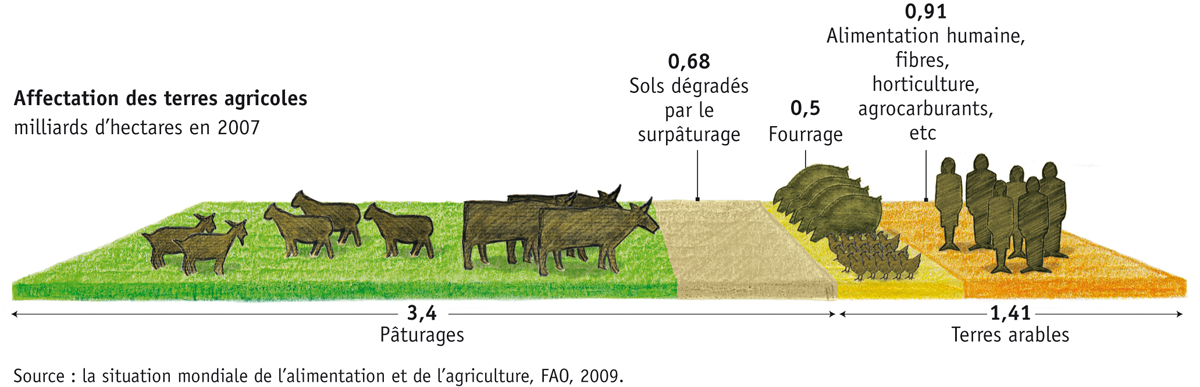
Pastures cover 60% of agricultural land, forage meanwhile occupies 35% of agricultural land. Thus in total, 81% of agricultural land are dedicated to livestock and its feed. Animal production in developed countries imports 80% of the proteins feed; mainly soya. Additionally, the irrigation of feed crops for cattle accounts for nearly 8% of global human water use, animal production causes 18% of the global greenhouse gas production, and manure affluent to the sea occasional cause algae blooms and “green tides”.  

In 2005 global animal production has used 742 million tons of grain, or about 250g grain per day and person of the global population. In 2009 more than 40% of global production of corn, wheat and barley was used for animal production; and 60% was used for all other uses, food and non-food. Animal production makes up for about 40% of the global agriculture production, and corresponds to 2% of the global GDP (2). Thus globally we use a very high fraction of land and water resources for a relatively minor total output.  

 Beef, pork or poultry -  not the same game.

The relationship between meat production and cereal input varies for beef, pork or poultry. It takes at least seven kilograms of grain to provide a single kilogram of beef, four kilograms of grain for a kilo of pork, two kilograms of grain for a kilo of poultry. Thus beef production is the least efficient use of grain and poultry production is the most effective; for the same amount of grain you get either two kilogram beef or seven kilogram poultry.

The annual global production of meat is about 280 million tons or 40 kg per person and year, a level of consumption recently reached for China or about one third of the consumption in the US. Most meat produced meat is poultry. The ratio of global production of beef, pork and poultry is about 25%, 35% and 40%, respectively. The ratio of grain production needed to produce these amounts of beef, pork or poultry however is 45%, 35% and 25%, respectively. Thus beef is the wolverine devouring most of the grain.  

  Action – target the beef.

Reducing meat production would reduce demand for grain. Reducing beef production would reduce most efficiently demand for grain. Capping beef production at a little less than half of the current level, thus from 45% grain consumption to 20% grain consumption, would free grain to double poultry production. This shift of meat production pattern would increase the global meat production by about 25% without changing total meat consumption  for meat-eaters. Another evident choice, however, is to consume less meat (beef) and  have more grain to nourish human beings, as likely will be needed by 2050. The amount of grain necessary to nourish more people could be made available by capping beef production.  

Poverty Facts and Stats; from [b]
Only a tiny fraction of the 25% increase of global population (plus 2 billion people) by 2050 will be among the richest fifth of the world's population; the main beef-eater (**). The additional people to nourish by 2050 are mainly grain-eater and only occasional meat-eaters. Thus, capping beef production in favour of making more grain available for direct consumption by people would provide food additional food resources.  These resources will be needed to nourish the global population of 2050. Halving the beef consumption of the richest fifth of the global population could free the resources to feed additional two billion poor people, in first instance and to current, although insufficient, standards.  

A modest change of consumption pattern for the richest fifth of the world population to free resources to nourish two billion human beings more.  Daydreaming?  

Ukko El'Hob

(**) p.s "Farm animal populations continue to increase worldwide. The number of chickens grown for human consumption increased 169 percent between 1980 and 2010, from 7.2 billion to 19.4 billion.1 During the same period, the population of goats and sheep reached 2 billion, and the cattle population grew 17 percent to reach 1.4 billion.... The Consultative Group on International Agricultural Research estimates that by 2050 the global poultry population will grow to nearly 35 billion, the goat and sheep population to 2.7 billion, and the cattle population to 2.6 billion animals." (found 27thJune: http://vitalsigns.worldwatch.org/vs-trend/farm-animal-populations-continue-grow) - thus,  cattle population forecasted to double by 2050?

(1) That includes the author and probably all readers.
(2) Worldbank figures indicate that the 2% estimate may be too high.
[a] Agnès Stienne in the blog of the “Monde Diplomatique” in the article “Quandl'industrie de la viande dévore la planète” (Meat industry devours the planet); my translation;  
[*] data are from: “Quand l’industrie de la viande dévore la planète” jeudi 21 juin 2012, par Agnès Stienne”;  [b] http://www.globalissues.org/article/26/poverty-facts-and-stats or  http://www.worldwatch.org/node/5443