Monday, 20 August 2012

The sucking sound in the ground

Groundwater hold in aquifers is a life-sustaining resource that supplies directly water to billions of people, for drinking, daily domestic use, agriculture and livestock. About 1.7 billion people live in areas where groundwater resources or groundwater-dependent ecosystems are under threat because of their over-exploitation. Thus, almost one-quarter of the world’s population lives in regions where groundwater is being used up faster than it can be replenished. Often it is a resource that was built-up under past climates as the Nubian Sand Stone aquifer under the Sahara.

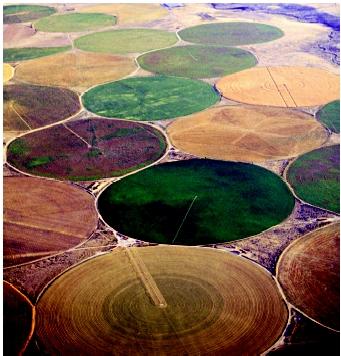
Fields irrigated with water from Ogallala aquifer
Often aquifers are over-exploited in are areas in which precipitation is scare or seasonal and  thus productive agriculture requires use of ground water, such as in the west of USA where agiculture is supported by the Ogallala aquifer. There use of ground water plays a central part in irrigated agriculture and  rising livestock that requires large amounts of water.  Likewise, presence of ground water is "just" beneficial for the health of many ecosystems, as for example it hinders intrusion of seawater into coastal plains.

Across the world, human civilisations depend largely on tapping vast reservoirs of water that have been stored for up to thousands of years in sand, clay and rock deep underground. These massive aquifers — which in some cases stretch across multiple states and country borders — provide water for drinking and crop irrigation, as well as to support ecosystems. Modern pumping technology and traditional property laws make water in these aquifers cheap and accessible to industrial agriculture. 
Water level drop up to 40 feet (deep brown)
between 1980 1nd 1995
Un-sustainable depletion of groundwater is described by a “groundwater footprint” [1]. The "groundwater footprint" is the area required to sustain groundwater use and groundwater-dependent ecosystem services. Currently humans are over-exploiting many large aquifers that are critical to agriculture, especially in Asia and North America  including many of the world’s major agricultural regions;  in the Central Valley in California, the Nile delta region of Egypt, and the Upper Ganges in India and Pakistan, demand exceeds these reservoirs' capacity for renewal.

The size of the global "groundwater footprint" is currently about 3.5 times the actual area of aquifers [1] because 20% of the world’s aquifers are being massively over-exploited. For example, the groundwater footprint for the Upper Ganges aquifer is more than 50 times the size of its aquifer.

Ukko El'Hob

Reworked from:


[1] Water balance of global aquifers revealed by groundwater footprint; Tom Gleeson, Yoshihide Wada, Marc F. P. Bierkens & Ludovicus P. H. van Beek & Groundwater use is unsustainable in many of the world's major agricultural zones. Amanda Mascarelli, NATURE,  08 August 2012

Tuesday, 7 August 2012

Folding Earth's Timeline

Evolution did a great job. Although, it took its time – 4.7 Billion years.  But how long are 4.700.000.000 years ? Any chance to feel how long is that elapse of time ?  How to fold that line of millions, billions of years so that it feels like a human timeline? 

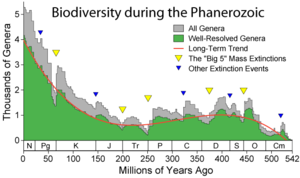
Marine Fossil Biodiversity since half a Billion years
(from Wikipedia)
What about counting years of Earth history as seconds of human life? Sixty seconds add to a minute, three-thousand six-hundred seconds add to an hour, eighty-six-thousand our-hundred add to a day, and thirty-one-million-five-hundred-thirty-six-thousand seconds add to a year (1); and so on.

A second feels like an elapse of time that we know. A year feels like an elapse of time that we know  too. A year counts for many seconds, namely thirty-one-million-five-hundred-thirty-six-thousand; what sounds “a lot”. That “thirty-one-million… number” does not feel specific, although a year feels specific and a second feels specific too.  So, feeling a second, feeling a year and feeling the difference between both elapses of time gives a quite particular spread of perception of how much that “thirty-one-million… something” is.  That spread of perception could be used to fold the timeline of Earth’s history onto a human timeline. 


A fairy tale…?

Thus, imagine to count a year as “a second of Earth's life”. Then, "a minute of Earth's life” would make most of a human life time. "An hour of Earth's life” would cover most of the period for which we, humans have some written records. "A day of Earth's life” would go back to times when our human species had evolved in Africa, just more or less ready to conquer the globe and to replace other human species. And "a year of Earth's life” would go back before modern fauna evolved, before continents had drifted to their present positions, before rapidly cooling Antarctica had become more isolated, and before the Antarctic Circumpolar Current had to start flowing. Thus within "a year of Earth's life” major biological, climatic and geological changes of the earth system occur.


Acasta gneiss, one of the oldest rocks on Earth. (2)
Counting a year as a “second of Earth's life” folds Earth’s history on timeline that can be captured by human perception. Counting 4.7 Billion years as 4,700,000,000 “earth-seconds” make hundred-forty-nine “earth years”. A human life would last 60 to 90 “earth-seconds”. Earth would have an age of 65 Million times the span of a modern human life. An enormous number, but counting only hundred-forty-nine “earth years”. One and a half century, that our perception can capture: it is back to times when grand-grand-parents were young, who are known from pictures made when they were old.

Ticking years as “earth-seconds” fold the time line of Earth history such that it looks imaginable for a human mind: It is mapping Earth's history on the lifespan of our grand-grand-parents, grand-parents, parents, us and our children. Thus four or five generations to illustrate the painstakingly long periods that have passed since earth formed out of stellar dust, since very first forms of life emerged, since more complex organisms emerged, and finally human beings conquered the globe.  


Fold one...- how long is a Billion or two?

Our planet, Earth evolves since about 4.7 Billion years since it formed as ball melting old stellar dust and ice into something new. Ticking years as “earth-seconds” Earth started to form nearly 150 “earth years” ago. A Billion “earth-seconds” counts for little less than 32 years.

Stromatolites at Hamelin Pool, Shark Bay.
Photo by Paddy Ryan
Ticking years as “earth-seconds", Earth emerged from stellar dust as grand-grand-parents were born. During their childhood Earth grew by more and more aggregation of interstellar dust and ice. Messengers from that time are iron-nickel meteorites that still today hit the Earth. When grand-grand-parents were youngsters the surface layer of the Earth cooled so far that rocks formed, first heavy basalts that are recycled  and then lighter granites and gneiss.

The oldest  rocks, Acasta Gneiss (4.3 Billion years) can be found in Canadian Northwester Territories.  Since chemical evolution of Earth was spinning up. And just about when grand-parents were toddlers, a Billion years of chemical evolution had lead to living cells (cyano bacteria). They were releasing oxygen into the world and evolution of Earth was made spinning faster. Living slim started to cover the rocky shores of the ocean. Since that time Stromatolites (3) are on Earth, from most ancient times until today. Once a sufficient amount of oxygen had been produced iron got oxidised and large iron ore deposits formed on Earth. Grand-parents were already old when the oxygen concentration in the atmosphere was approaching levels that we know today. Thus it took live span of two generations - about half the history of the Earth or more than 2 Billion years – to evolve from molten stellar dust to planet with reddish land, blue oceans and slimy live along the shore.


Fold two... -how long are some Millions?

Modern terrestrial animals, about as we know them, thus mammals exist since about 50 Million years. The geological epoch when they emerged (Eocene) started after 99% of Earth’s history had passed already. It started warm, and wide oceans created a moist global environment. Apart from the driest deserts forests were spreading from pole to pole and they would look reasonably familiar to our eyes. Dinosaurs had started off, lasted for more 180 Million years, and had disappeared well before. Trilobites in the sea had started off half a billion years ago, lasted for 300 Million years and disappeared before Dinosaurs.

Trilobite Genevivella grannulatus
(from http://www.collectingfossils.org/index.htm)
50 Million seconds are close to one and a half year. 180 Million seconds are little less than 6 years, and 300 Million seconds little less than 10 years.

Ticking years as “earth seconds” and thinking in generations, the Eocene is part of a my very recent past; me being now 32 years. Dinosaurs I saw some years ago, as well as Trilobites as I was still an adolescent. Grandparents, as they were young have seen first Stromatolites and other microbiological mats along the shore line of the sea. Forefathers mostly knew rocks only, and witnessed bio-molecules emerging from more simple chemistry, but parents, I and my children saw and see life conquering Earth. 


Fold three...- how long is a Million or two? 

Evolution of our species;
~3,  ~1 and ~ 0.2 Million years ago
(from: http://mephisto-1061.skyrock.com/)
Early human beings (species "homo erectus") evolved about 1 Million years from earlier human-like species. These species evolved three to four million years ago leaving apes well behind them;

Ticking years as “earth seconds” one million seconds are a little more than 11.5 days, and four million seconds are about one and a half month.

Thus folding time scales – counting years as “earth seconds”, human beings emerged on Earth a little earlier this month, agriculture started just three hours ago, steam engine’s puffing was heard three minutes ago, and the first atom bomb blow up a minute ago.
Watt's Steam-Engine  as granted a patent by Parliament
(from: http://www.spartacus.schoolnet.co.uk/)

A fair story…!

So, our human history is a story of minutes or hours when it is counted in “earth seconds”. Counting "earth seconds", living plants and animals populate the planet since some years, at best since two decades; first in the sea and much later on land.  On the same folded time scale,  the beginning of microbiological life on our planet dates back hundred to hundred-twenty years from today, or up to four Billion “earth seconds” ago.

Thus evolution took its time and sized its chances. It is to us to preserve it in the anthropocene.

Ukko El'Hob


p.s. If you like to read more about Earth's history over billion of years then I recommend  "The Story of Earth: The first 4.5 Billion Years, from Stardust to Living Planet" by Robert M. Hazen.

(1) Approximating the year to 365 days. The sidereal years has 365 days, 6 hours, 9 minutes and 9.54 seconds, or 31,558,149.54 seconds.

(2) The contorted white bands in the Acasta gneiss consist of quartz and feldspar, two minerals common in granite. Their occurrence tells us the gneiss was metamorphosed from granitic rock contained in Earth's earliest continental crust. Most granite forms by melting of an older basaltic crust in the presence of water, rather than by direct melting of Earth's mantle. Thus, the Acasta gneiss provides indirect evidence for the presence of water on the early Earth, and for a basaltic crust that formed before 4.03 billion years ago. Photo by Chip Clark, NMNH. (Smithonian)
(3) Stromatolites are formed in tidal zones by colonies of cyano bacteria accumulating sand grains into layered structures.

Sunday, 24 June 2012

Cut beef in two and feed two billion


“Population projections of the United Nations (UN) show that the planet will host nine billion people in 2050, time when world population begins to stabilize. A wave of panic on the planet, some raising the spectre of overpopulation ... Will there be enough resources and food for all while already, in 2011, over one billion people stay hungry?  In recent years, countries that feared a shortage embarked on a frantic race to acquire new agricultural land being fought over between the food and bio-fuel industries. And a fierce debate is ongoing between those who want to use agricultural products to run the engines for those who prefer to nourish human beings.  Only few complain a business even more voracious in natural resources, agricultural products and space: that of the meat industry.[a]”

Global food availability is out of balance, although the total amount of food currently produced is sufficient. Currently more than one billion people suffer from hunger and a little less than two billion people suffer from overweight. That confirms imbalance not shortage. However the current situation will get tight. The global human population will grow by further two billion people, or more than a quarter, before it stabilizes around year 2050. These additional people have to be nourished using the land currently available. Global food production patterns have to change to secure that, meat production seems to be an appropriate target to free resources [*].

 Who eats meat?

Sausages
Those who can pay for it. At least 80% of humanity lives on less than $10 a day and the poorest 40% of the world's population accounts for 5% of global income. The richest fifth of the world's population accounts for 75% of world income. The poorest fifth for just 1.5% [b]. The richest fifth of the world's population (1) eat most of the meat that is produced on the planet because they can afford it; and their choice determines the pattern of global production of meat.  

Many, even most people like to eat meat. Our evolution set our species on a trail to live on a variable diet; e.g. vegetables, fruits, grains from plants and meat from animals or fish. However, only the better off on this planet have the choice “what to eat”. The World Bank noted already in 2011 that global food prices are reaching dangerous levels. Rising food prices threaten to push millions of people into poverty and put particular pressure on the most vulnerable, who already spend more than half their income on food. Thus many people simply eat “what they can get”.

 How do we produce our – daily - meat?

Green tide - massive algae growth
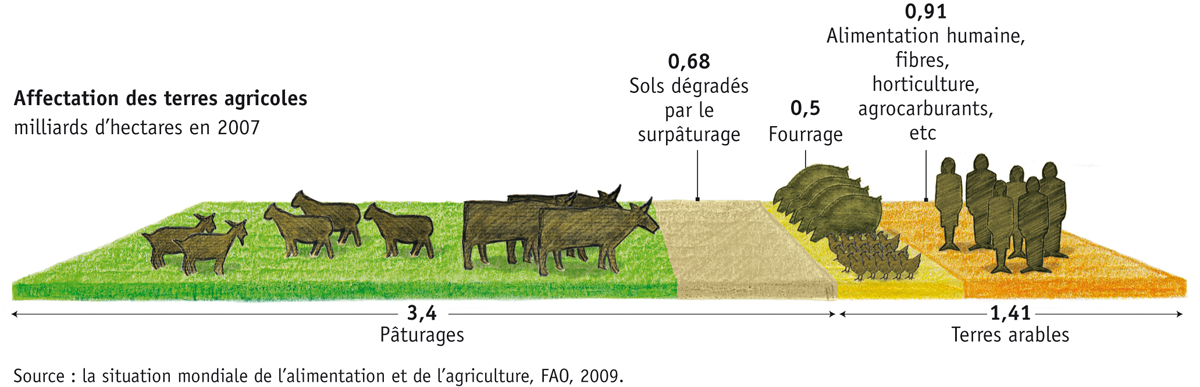
Pastures cover 60% of agricultural land, forage meanwhile occupies 35% of agricultural land. Thus in total, 81% of agricultural land are dedicated to livestock and its feed. Animal production in developed countries imports 80% of the proteins feed; mainly soya. Additionally, the irrigation of feed crops for cattle accounts for nearly 8% of global human water use, animal production causes 18% of the global greenhouse gas production, and manure affluent to the sea occasional cause algae blooms and “green tides”.  

In 2005 global animal production has used 742 million tons of grain, or about 250g grain per day and person of the global population. In 2009 more than 40% of global production of corn, wheat and barley was used for animal production; and 60% was used for all other uses, food and non-food. Animal production makes up for about 40% of the global agriculture production, and corresponds to 2% of the global GDP (2). Thus globally we use a very high fraction of land and water resources for a relatively minor total output.  

 Beef, pork or poultry -  not the same game.

The relationship between meat production and cereal input varies for beef, pork or poultry. It takes at least seven kilograms of grain to provide a single kilogram of beef, four kilograms of grain for a kilo of pork, two kilograms of grain for a kilo of poultry. Thus beef production is the least efficient use of grain and poultry production is the most effective; for the same amount of grain you get either two kilogram beef or seven kilogram poultry.

The annual global production of meat is about 280 million tons or 40 kg per person and year, a level of consumption recently reached for China or about one third of the consumption in the US. Most meat produced meat is poultry. The ratio of global production of beef, pork and poultry is about 25%, 35% and 40%, respectively. The ratio of grain production needed to produce these amounts of beef, pork or poultry however is 45%, 35% and 25%, respectively. Thus beef is the wolverine devouring most of the grain.  

  Action – target the beef.

Reducing meat production would reduce demand for grain. Reducing beef production would reduce most efficiently demand for grain. Capping beef production at a little less than half of the current level, thus from 45% grain consumption to 20% grain consumption, would free grain to double poultry production. This shift of meat production pattern would increase the global meat production by about 25% without changing total meat consumption  for meat-eaters. Another evident choice, however, is to consume less meat (beef) and  have more grain to nourish human beings, as likely will be needed by 2050. The amount of grain necessary to nourish more people could be made available by capping beef production.  

Poverty Facts and Stats; from [b]
Only a tiny fraction of the 25% increase of global population (plus 2 billion people) by 2050 will be among the richest fifth of the world's population; the main beef-eater (**). The additional people to nourish by 2050 are mainly grain-eater and only occasional meat-eaters. Thus, capping beef production in favour of making more grain available for direct consumption by people would provide food additional food resources.  These resources will be needed to nourish the global population of 2050. Halving the beef consumption of the richest fifth of the global population could free the resources to feed additional two billion poor people, in first instance and to current, although insufficient, standards.  

A modest change of consumption pattern for the richest fifth of the world population to free resources to nourish two billion human beings more.  Daydreaming?  

Ukko El'Hob

(**) p.s "Farm animal populations continue to increase worldwide. The number of chickens grown for human consumption increased 169 percent between 1980 and 2010, from 7.2 billion to 19.4 billion.1 During the same period, the population of goats and sheep reached 2 billion, and the cattle population grew 17 percent to reach 1.4 billion.... The Consultative Group on International Agricultural Research estimates that by 2050 the global poultry population will grow to nearly 35 billion, the goat and sheep population to 2.7 billion, and the cattle population to 2.6 billion animals." (found 27thJune: http://vitalsigns.worldwatch.org/vs-trend/farm-animal-populations-continue-grow) - thus,  cattle population forecasted to double by 2050?

(1) That includes the author and probably all readers.
(2) Worldbank figures indicate that the 2% estimate may be too high.
[a] Agnès Stienne in the blog of the “Monde Diplomatique” in the article “Quandl'industrie de la viande dévore la planète” (Meat industry devours the planet); my translation;  
[*] data are from: “Quand l’industrie de la viande dévore la planète” jeudi 21 juin 2012, par Agnès Stienne”;  [b] http://www.globalissues.org/article/26/poverty-facts-and-stats or  http://www.worldwatch.org/node/5443

Sunday, 10 June 2012

Letter to my Cousin - no thanks, no "horror show" please


Dear Cousin,

Karhun Ukko
our correspondence took us the last month  through a kind of circular walk. We set of with your question How... be certain "what reality is about"? Now, your last comment about spiritual experiences brings us back to the subject of my first letter, namely "what is reality?"

The ability to have spiritual experiences is an easily activated trait of human mind [1], important for our values and perception of the world. Nevertheless it is a state of mind and thus its content is "virtual" although the underpinning process in our body are real. How clearly you describe this, when starting of saying “I have troubles to describe....”.  Being "able to describe" in a manner independent from the individual is a very critical feature of what is reality about. You continue saying “a spirit coming into your own spirit and into your imagination and convincing you about something Godly that transcends reality but can be experienced within yourself.” Thus you capture the functioning of the mental process in our inner, “virtual” world, which generates “flash-like mental insights”.  The ability to generate these “flashes” are important traits of our brain (mind). Possibly developing them was very valuable for our survival along our evolutionary path [2].  

What scares you to read...?
Admittedly, I'm a bit appalled by the quote from the famous and respectable John Updike [3] that you refer to "If God does not exist, this world is a horror show.  This world is not a horror show. Therefore God does exist". Appalling is not the quote itself, but what could be derived from it. Likely John Updike made this statement in the early fifties, thus shortly after World War II, Korea-war being in full swing etc.; and nuclear arms race had started with real threat for mutual mass destruction. That certainly was a time of (its) horrors.  

Before describing why that quote is appalling, I cannot hinder the temptation to point out that its starting statement “If God does not exist, this world is a horror show” is flawed, if it is taken literally in a common religious context. Namely, “no god” would mean “no creation” and thus nothing what could manifest itself as horror or recognizing horror; so logically: “no god”, “no creation” and “no horror show”. Putting this aside; what makes it appalling to consider "that humans need god so that this world is not a horror show"?  

Certainly we can assume that John Updike's statement refers to (our) human societies and not the ample world “before humans” in which and for which ethical considerations and moral appreciations have no meaning. Although, having said that, we have to keep in view that part of the attitudes, which we consider ethical or non-ethical, are found among primates; including warmongering among chimpanzee groups!  Thus possibly human ethical considerations have their precursors from which they emerged before fostering cooperation in groups of early human species. 

Sculpture of the Swedish artist C. Milles
Reading John Updike's statement I feel a bit disgusted because it seems to state that you (and I), our relatives, our fellow human beings need a god to render this world a lesser horror show. That seems to be said. To put it simple – should I assume, that humans behave in a more ethical manner because “god” reminds them to do so? I would consider that as insulting any of my relatives or fellow human beings and their ethical standing. Beyond that sentiment, "cui bono" [*] may be asked when advocating that humans behave in a more ethical manner because “god” reminds them to do so? This question leads to study the various social functions of religion and faith, a matter on which I have dwelt a bit previously.

As a teenager I found in my parents' bookcase a mince book, which I still have in my own bookshelf: written by Lin Yutang [4]. One of its sections, which is critical regarding religious believes could be summarized as: Should you be good person, because you are threatened with hell or rewarded with heaven? Or should you be a good human being on your own thinking?

Faith or God are not needed for behaving like a good person. Most humans know well enough what that implies. Sadly, faith-based reasoning is regularly turned into thought to justify non-ethical behaviour and horror-show? Causes being presented as faith-based are far more difficult to question, thus "cui bono"?

Thus I like to take firmly side - sapere aude [**] , or trying to being a good human on your own thinking. 

with Ukko's best wishes,
your Cousin


[*] Commonly the phrase "cui bono" (Latin) is used to suggest a hidden motive or party responsible.


[**] from Wikipedia: Sapere aude is a Latin phrase meaning "dare to be wise", or more precisely "dare to know". Originally used by Horace, after becoming closely associated with The Enlightenment by Immanuel Kant in his seminal essay, What is Enlightenment?. Kant claimed it was the motto for the entire period, and used it to explore his theories of reason in the public sphere.


[1]  Born believers, Justin L. Barret, New Scientist 39, 17th March 2012

[2]  On mental and thus social side of the evolution of our species; “The social conquest of the earth” by Edward O. Wilson


[3]  from Wikipedia: John Hoyer Updike (March 18, 1932 – January 27, 2009) was an American novelist, poet, short story writer, art critic, and literary critic. Updike's most famous work is his Harry "Rabbit" Angstrom series, which chronicles Rabbit's life over the course of several decades, from young adulthood to his death. He published more than twenty novels and more than a dozen short story collections, as well as poetry, art criticism, literary criticism and children's books. Hundreds of his stories, reviews, and poems appeared in The New Yorker, starting in 1954. He also wrote regularly for The New York Review of Books.

[4] Lin Yutang (October 10, 1895 – March 26, 1976) was a Chinese writer and inventor. His informal but polished style in both Chinese and English made him one of the most influential writers of his generation, and his compilations and translations of classic Chinese texts into English were best sellers in the West.


Sunday, 27 May 2012

Letter to my cousin - what to make of "God the creator"


Karkun Ukko
My dear Cousin, who's name is program, you suggested recently to make live and thinking simple: at the beginning of time all matters start with God.

However, why shall I believe that “god the creator” is needed to fill a void before existence of our universe? Interesting slip of tongue, with a logical contradiction build in: "void before existence of our universe". I will come to that later - our language can be dubious - here it gives the message that the universe exists in time-space frame, so that notions of "void" and "before" make sense.

My cousin, you understand this “god the creator” as being eternal and omnipotent. Fair, that is a view shared by many human beings. Apparently for many of us it seems imperceivable to take the view that  the universe is eternal and evolving from Big Band to Big Crunch.  However that's not so curious neither considering the strangeness of "Big Bang Physics" [*] and their remoteness from our regular experiences. Thus, let us not bother about physics of the Big Bang, but  let us to set off the argument asking what is the difference between both concepts the “eternal god the creator” and the “eternal universe”?  

...as far as we can look back - cosmic microwave background
There are many differences between both concepts, but there is no difference regarding the specific notion “eternal". Saying "it is eternal" gives an answer to one of the old, basic concerns of humans, namely “from where do we come”? So we may take the view that we came alive as part of the eternal universe. Or we may take the view that the eternal god created the universe and us within.  Introducing “god the creator” increases complexity of view - one more instance to handle – to get the same answer, namely we are emerging out of something that is eternal.  So why not keeping things simple and settle for a philosophy or religion that consider an “eternal universe” instead an “eternal God that created the universe”? What do we, humans, gain from being attached to the concept “God the creator”?

At first view; possibly many of us perceived it as awkward to share the same universe with the God in which they believe? Sharing the universe seems to violate somewhat the "natural hierarchy". Nevertheless this “shared coexistence” exists somehow in pantheism.  Admitted too; “simplicity of a notion” is not an approach of many, although “Occam's razor” as such an approach is called, is used by many critical thinkers - before, during and after Occam's live in the late Middle Age (William of Ockham (c. 1285–1349)). Thus if  “simplicity of a notion” is not a criteria to make a choice, then other causes have to be found why so many like the concept of  “God the creator”.

Isis and Horus - Egyptian gods
First comes to my mind when considering the above, that the notion “God the creator” enshrines a very simple concept. It propose simply a omni-potent agent to take care of anything that I do not understand. Therefore, if I know little, if I feel insecure, or if I have many questions to which I do not know an answer, then referring to “God the creator” is comforting. Being subject to an omni-potent agent, which I can keep friendly by behaving rightly, sound familiar for may "wordily" settings and thus fits our state of mind easily and,the notion “God the creator” is just a straight extrapolation of  many things that we experience.

Second  comes to my mind, and possibly it is quite relevant, that the notion “God the creator” leads to a very powerful concept. God-believe gives purpose to the believer, because the believer perceives being created to achieve predefined goals. This is appealing to us, because giving purpose to acts and deeds is a very deeply routed human trait. Thus gaining trust that our own existence has purpose is comforting for us. Purpose-bound action reflects a very basic features of our mind, which evolved coupled to both the evolution of self-consciousness and the evolution of our ability to plan acts and deeds that shall secure our survival. As purpose comes, in mind, naturally with values supporting these purposes, consequently conventions and rules adopted by humans are easily understood as projected from god instead of being man-made. And that feature is very much the core of the function of religion - projecting  common conventions and rules to foster cooperation among humans.

Third comes to my mind, that the notion “God the creator” provides not only purpose to all humans but also provides certain believers with the additional option to feel empowered to guide and lead. Believing in their empowerment and somehow been followed by fellow-believers these individuals can act as charismatic leaders  – please consider as examples shamans, apostle or priests.  Thus the notion “God the creator” leads too to leadership and governance, which is an important element for cooperation between humans. An additional consequence, possibly also part of the evolutionary advantages of the evolution of charismatic leadership, is that charismatic leaders get an option to access better the resources of the group that they lead.

Thus,  the concept “God the creator” lays foundation to some important functions of the human mind and consequently to actions in society.  Some interesting further observations can be made in junction to the notions of god that can be derived from the concept "God the creator".

San people preparing a hunt
As “God the omni-potent” takes care of my uncertainties and believing in this fosters a state of mind of increased confidence in achieving my plans. Possibly unhappily for the believer, this view of god is very much the "god of the gap". Not really god-like that god fills the knowledge gap. Consequently increasing knowledge and decreasing  uncertainties reduces motivation of be believer to underwrite to that particular notion of god. Historically we witnessed that development during the last centuries after science and research emerged in modern societies. Not surprising neither is that fundamentalist believes often come together with hostility towards science and research. A desperate attempt to keep the knowledge gap open, and thus to maintain the advantage of increased self-confidence because   “God the omni-potent” takes care of me.

As “God source of purpose” gives purpose to me and my fellow-human beings it creates a state of mind of comfort and confidence in my goals or, more relevant, confidence in common goals.  Thus this notion of god increases group confidence in achieving common plans. This is an advantage in an evolutionary and historical context. Consequently  the likelihood to achieving common plans is enhanced compared to humans that do not have that common tweak to their minds. Thus adopting the concept of  “God source of purpose” enhanced  cooperation among humans, in particular for bigger groups involving many members that do not know each other personally. Favouring purpose-bound state of mind seems to be a concept easily accepted by our mind. That preferential state of mind likely evolved with us because it helped survival of better cooperating groups. Better cooperation enhances the access to scare resources that are needed to secure reproduction and thus survival of the group, species.

As “God source of purpose” furthers some charismatic individuals to consider that the purpose of their individual acts aligns with purpose set by god a particular social function emerges among fellow-believers - enforced cooperation. Thus, it can be said that Charismatic believers being righteous, in the sense being aligned with god's purpose, gain access to “God source of power”. Combing their charisma with common believe in purpose they can enforce far-range collaboration; in first instance of the fellow-believers by coordinating peer-pressure transmitted through networks in the group; and in second instance by coordinating vast group action against non-believers, basically  to compete for resources. The enforcement of collaboration may take the form that “worldly” power is projected or that cooperation  is coerced by calling on common insight of the fellow-believers. History is full of examples for the power-projecting by charismatic individuals. In most cases by charismatic religious believers, but there are other examples too of  charismatic individuals using the same cognitive mechanisms of  peer-pressure and power projection but referring to political notions. History illustrates also copiously how  charismatic individuals (and their disciple) get enhanced access to resources of the group.  Favouring charismatic leaders - today we call these "superstars" - seems to be a concept easily accepted by our mind. That easily assumed state of mind likely evolved with us as species because it helped to enforce better cooperation in large groups. Better cooperation enhances the access to scare resources that are needed to secure reproduction and thus survival of the group, the species.

African savannah
So my cousin in view of the considerations developed above, I could share the notion that "at the beginning of time all matters start with God". However that metaphor takes reflects on an evolutionary process in which believing in "god the creator" is at the root of mind-processes that facilitate development of cooperation in groups, even if that cooperation has a cost for many individuals higher then the direct benefits. Fostering cooperation was beneficial for the survival of our species, even if the cost of believes for some individuals were prohibitive (e.g. refer to martyrs for an extreme case) and cost for the societies were high. These mind-process are part of our very basic mental wiring and thus they are easily activated and difficult to overcome [1]. They can be overcome as far as the concept "god the creator" is replaced by more secular understanding. That process of replacement  is historically young, some centuries only, and the struggle for spreading more secular understanding in our societies will be long. It may never end as purpose-based reasoning is so deeply rooted in our mind as it evolved since early human species left African savannah. It is difficult for us, as our species evolved, to accept that we live in a purpose-free universe and have to set autonomously the purposes of our acts, deeds and lives. 

with Ukko's best wishes,
your Cousin

[*] Big Bang Physics is not what many like to favour compared to believes in “God the creator”. Although Big Bang Physics is the best available description of how our universe evolves – at the beginning jointly emerge space, time, energy, matter and the laws particular to our universe describing their respective interplay. Thus the notion “before the Big Bang” does not makes sense, neither “what set of the Big Bang” if we seek an evolution. Our particular “space, time, energy, matter and the laws to describing their interplay” emerges by the Big Bang. Thus we are bound in this frame; notions like "outside" or "before" bear a useful meaning only inside the universe.  


[1] for related reading:  Born believers, Justin L. Barret, New Scientist 39, 17th March 2012; Religion, Economy, and Cooperation, Ilkka Pyysiäinen (ed.), De Gruyter 2010


Wednesday, 9 May 2012

Letter to my Cousin - my virtual inner world


from:
http://tekka-globalvillage.blogspot.com/
My dear cousin,  

you asked "our inner worlds, real in the end"? Let's resume:


My inner world is real but outside reality. Reality is simply my outer world, namely: Reality is an outer world in opposition to my inner, imagined or virtual world of thoughts, memories or feelings. Reality, the outer world is mutable through me, it is world in which I can reproduce ideas that I draw from my inner world. It is independent of me as individual and my culture. It is acquired by methods that are independent of my believe, culture and lifestyle, and the applicability of my understanding of reality is independent from me as a user.” (1)

"Interesting concept, but your concept of "reality" suffers from the fact that it eradicates from it the world of feelings, and even culture. That goes against experience of life. A more appropriate definition of "reality" should include the ponder-able difficult, the imprecise, the unpredictable and the irrational. Otherwise your world would be without taste or fun, and possibly a world without respect for the other.” (2)

"Well, if we add feelings, ideas and other "content" of our inner world together with the systems that support our information processing, into the notion of "reality", then there are so many realities as there are intelligent beings (e.g. Humans if we take an anthropocentric view). That does not seem helpful to survive.. We should describe this inner worlds of us in a different manner, just to incorporate appropriately the ponder-able difficult, fuzzy and unpredictable." (3)


Admittedly, my dear cousin,

Karkun Ukko
I make a choice in applying that (1) notion of “reality”. Admitted too, other notions of reality (2) are more “en vouge”; humans are discussing “meta-physic” since ages and make and made different choices. I make that particular choice, because I think, in my inner world, that it matters. It matters I think, because is helps to understand, to act, and to respect. And I value, in my inner world, the capability to understand, to act, and to respect.

Let's step back. We "humans are intuitive dualists in the sense that we feel our self to be owner of the body, but we are not the same as our bodies" [1]. Thoughts, feelings, ideas are real, somehow, but how? Thoughts, feelings, ideas are part of our self-contentiousness that too is part of our inner world (3).  

Practice and cooperation is the key to understand the choice that I favor. The interaction between our inner world and our outer world, thus what I like to name “reality”, may be functional or dysfunctional depending on the outcome of actions - outcome as it is occurring in the outer world. However, whether an interaction is perceived by a person as functional or dysfunctional depends on the actor's or observer's “view”. Thus it is relative. Being functional or dysfunctional is a value statement “operated” in the respective inner world, when the outcome of an action is assessed.

Value statements are not innocent and they are genuine to the inner world. Value statements matter if cooperation between actors, thus common practice is relevant. Thus understanding of reality, and in the end “understanding what is reality” matters to the degree that cooperation and common practice is needed. Cooperation and common practice among humans is needed to live together and to reproduce. This imperative of cooperation and common practice makes it necessary for humans to have a common view on reality; at least for the specific group of humans that has to cooperate at a certain time and space.  

Venus von Willersdorf in different context
Conceptually, such a group has the options to forge the same inner world (in all its members) or to limit cooperation to individuals having very similar inner world. Then their action would be common. However, for that closed group (of “believers” having a similar inner world) remains the issue how the outer world reacts to its actions. Notwithstanding side-effects, as long as this reaction (of the outer world) does not jeopardize the ability of that group to reproduce, and this in the plain biological sense of the notion as well as in the cultural sense of the notion, their live could go on. Matters getting complex if one closed group is impossible to set up; what is a feature of the world in which we live; the emerging global vilage.  

Thus it seems to be more practical, than “forge the same inner world”, to take the most simple option, namely: "Reality" is the outer world in opposition to our inner, imagined or virtual world of thoughts, memories or feelings; and to respect the differences of inner worlds as individual traits. 

We all have the necessary experiences to take this option: We know that our body is a system that supports processing of information captured by our senses. We know that our senses are different, limited and not of same quality for all individuals. We know that our body in turns the received information into feelings, ideas etc. thus into our rich inner world. Thus we should modernize our notions and take feelings, ideas as “content” of inner world.

In context of information technology the word “content” is used to distinguish the “inner world of ideas, messages...” from the physical systems (computer) that processes the information that in turn is representing the content. Does this make “content” without taste and fun? Does this make "content" to a part of reality? No!  Does "content" has impact? Yes!

Cave paintings Altamira
Intelligent beings, e.g. humans debating what is reality since ancient times. Our Mediterranean-centric culture traces that discussion back for some thousand years. Research indicates that human beings handle symbolic content since late paleolithic times. Firm evidence shows that humans of the homo sapience species, first in Africa, as well as late Neanderthals were capable to handle a sort of symbolic representations that underpins language, art and religion. Thus they had an “inner world”.

Its speculative how much older is this human trait. Possibly it was a key evolutionary advantage that our body evolved a system, namely brain and nerves, which process information about the "reality" in an inner, virtual world of its own dynamic. That world has a fantastic flexibility, which may deliver a wide range of feelings, concepts and ideas and our body provides the means to express them. We can test these feelings, concepts and ideas in cooperative manner with other intelligent beings. We talk, act and shape objects; thus we modulate reality. Our fellow human beings are subject to these actions, process the information that their senses capture about these actions, processes further this information in their inner worlds, and react. And culture emerges through cooperation.  

Thus, my dear cousin, I make a choice in applying this notion of “reality” (1). I make that particular choice, because I think, in my inner world, that it matters (2). It matters because is helps to understand, to act, and to respect. So that the common global village can be a nice place for us (3).


with Ukko's best wishes,
your Cousin


[1] quoted by Ilkka Pyyisäinen, Marc Hauser (2009) "The origins of religion: evolved adaptation or by-product" (Http:.//www.project-reason.org) from Bloom, P. (2004) "Descartes Baby: How the Science of Child Development Explains What Makes us Human"

Tuesday, 1 May 2012

Letter to my cousin, whose name may be program


Karhun Ukko
Dear Christian, 

you asked, how Ukko could be certain "what reality is about"?

A debate "what reality is about" means to go philosophical. Setting of, one would like to recall that our memory does not provide for a clear distinction between a remembered vision, imagination, delusion or remembered events or experiences. Everyone can experience this, and that experience is important to gain insight "what could be reality”. 

Our fuzzy inner world of thoughts, feelings and memories is "blurred" and memories of experienced reality and fantasy is getting mixed up, all time. In passing; that “blurring” is at the root of our freedom of choice, but that's another debate.

Our fuzzy, inner world of thoughts, feelings and memories is a powerful "virtual world" in which we link concepts, thoughts, feelings and memories and so on. Our body - nervous system, brain... - that plays this "virtual world" is related to processing concepts, thoughts, feelings and memories just as a computer (software and hardware) is related to playing the game, running the controller, or processing the image. The notion "reality" does not comprise these inner "virtual world” but comprises our body and the processes occurring in it. That I call a first aspect of reality: it is an external world, which stands in opposition to our inner “virtual world”.

Prehistorical skydisk - Nebra (Germany) 
This opposition, or segregation of virtual “inner world” and real “outer world” comprises however that I, as person, can modify the "outer world" by means of actions undertaken by my body. I undertake these actions because of concepts, thoughts, feelings and memories stemming from my "inner world", a strong and vigorous driver. That I call a second aspect of reality: I can modify it to represent something that I draw from my "inner world".

The "inner world" of ideas is very diverse, a diversity which is probably unlimited. We name "fantasy" or “dreams” these concepts or ideas that can not be represented in the "outer world". The processes in our body that happen to represent a concept are closely connected with the concept itself. The processes are part of the reality, the idea is not. According to Descartes, "Cogito ergo sum", I think therefore I am, and not: "the idea is".

From Terry Gilliam's 1988 movie
The Adventures of Baron Munchausen;  John Neville & Eric Idle
build a hot air balloon made from women's lingerie
How can I now recognize this outer, changeable world, which also includes my body and thus to some extent is happening “in me"? I would like to mention three other aspects that help to distinguish between something that is "part of reality" from something that is "not part of reality".

Initially it may seem paradoxical;, even though “reality” is a part of our individual experience, it can only be determined in segregation from these individual experience. However this paradox is commonplace, as an example shows. Only the degree differs to which we accept it depending on our respective culture. In our western, rational culture nowadays most exclude from reality the experiences made in a dream when they sleep; some other cultures see this very different. A dream may be  remembered after waking up. However, the matters experienced in the dream is - in our culture - not part of the things, which are existing. In our culture a dream is not considered being part of reality, the process of dreaming however. Reality is the part of individual experiences, but having a content that is independent of the respective person and that can be understood by everyone, because to acquire (this experience) you are not bound by your individual beliefs, culture and lifestyle. That I call a third aspect of reality: it is independent from the individual and its respective culture. 

Understanding of reality is determined by activities that can be named as "to observe" or "to examine" and that are confirmed by "practising". Understanding of reality can only be won if methods of observation and methods of investigation are used that are accessible to all people - or worded stricter: to all intelligent life forms. Identifying reality requires that people of any belief, culture, lifestyle - as far opposed they may be - will be lead to similar insights, when they use the same observation / analysis methods. That I call a fourth aspect of reality: knowledge of reality is acquired by using methods that are independent of beliefs, cultures and lifestyles.

Understanding of reality is tested by applying the insights gained previously through observation and examination, thus to practice it. Things are modified, influenced or their behaviour is predicted, etc.; the practice being the same depending on the insight but not depending on the individual applying it. That I call a fifth aspect of reality: the applicability of the insight in reality is independent of the user.

In summary, Christian, I see five important aspects that help to determine what is "reality" and what it is not, namely:

Reality is an outer world in opposition to our inner, imagined or virtual world of thoughts, memories or feelings. It is a world mutable through us, it is world in which we can reproduce ideas that we draw from our inner worlds. It is independent of us as individuals and our cultures. It is acquired by methods that are independent of beliefs, cultures and lifestyles. And the applicability of the understanding of reality is independent of us as a user.

Magellanic Clouds,Milky Way above the Patagonian Andes
ngm.nationalgeographic.com
This is enough for me to have certainty, "this is reality." A thought  of caution arises when considering that we have witnessed only a limited set of  beliefs, cultures and lifestyles or of methods of observation and methods of investigation. So we may have some kept some spurious insights, but then Occam's razor [1] and test of insight through practice: "does it function", "can we built it", "can we forecast it" provides for sufficient firm ground, thus reality.

Using these considerations regarding "what is reality" and making a few additional considerations it can be shown that the notion "God" belongs to our own virtual "inner world" only, and God is not part of reality. Further-on, the current notions of God can be be shown to have a common internal contradiction, namely that it can be refuted by "reductio ad absurdum." This is not a negative proof of God, but practising the philosophical thinking of Ludwig Josef Johann Wittgenstein [2]. For everyday use, this is sufficient to be an atheist, as a divine intervention can be ruled out in reality and as reality.

To use a mental concept of God in a (my) virtual inner world, is unaffected by the above. It just taking advantage of the freedom of our inner virtual world; being certain about the utility of the concept is possible too, and firmly convinced of its / His being likewise. Why should I do so; may be because I like this as motivation or it calms  feelings or fears? It too remains a residual risk for the atheist to face as part of reality that a person that agitates or attacks you, motivated by its notion of God and the related excitement. Let it be; take it just as Goethe's "Prometheus" [3]:

Bedecke deinen Himmel, Zeus, ...
Mußt mir meine Erde / Doch lassen steh'n,
Und meine Hütte, / Die du nicht gebaut,
Und meinen Herd, / Um dessen Glut
Du mich beneidest...

...Wähntest du etwa, / Ich sollte das Leben hassen,
In Wüsten fliehn, / Weil nicht alle Knabenmorgen-Blütenträume reiften?
Hier sitz' ich, forme Menschen / Nach meinem Bilde,
Ein Geschlecht, das mir gleich sei, / Zu leiden, weinen,
Genießen und zu freuen sich, / Und dein nicht zu achten,
Wie ich!

with Ukko's best wishes,
your Cousin

[1] from Wikipedia:  The principle is often summarized as "other things being equal, a simpler explanation is better than a more complex one. Bertrand Russell offers a particular version of Occam's Razor: "Whenever possible, substitute constructions out of known entities for inferences to unknown entities." Occam's razor is attributed to the 14th-century English logician, theologian and Franciscan friar Father William of Ockham (d'Okham), although the principle was known earlier. Ptolemy stated "We consider it a good principle to explain the phenomena by the simplest hypothesis possible". To quote Isaac Newton, "We are to admit no more causes of natural things than such as are both true and sufficient to explain their appearances. Therefore, to the same natural effects we must, so far as possible, assign the same causes."


[2]  born 26 April 1889 in Vienna, † 29 April 1951 in Cambridge; see: "Tractatus Logico-Philosophicus" (1921)


[3]   Goethe's "Prometheus":   http://www.youtube.com/watch?v=qAFmidV0hUk&feature=related